Introducing Jais-ASR: Arabic Speech Recognition for Every Dialect
State-of-the-art Arabic Speech Recognition across Modern Standard Arabic and 19 dialects, with support for code-switching, diacritization, and built-in language identification.
Octorber 2026 · Institute of Foundation Models
Artifacts
Socials
Overview
Today, IFM is releasing Jais-ASR, an open speech recognition model built for the realities of spoken Arabic, including natural code-switching with other languages. It delivers state-of-the-art performance on Arabic, covering Modern Standard Arabic and dialects across 19 Arab countries, from east to west, including varieties that remain barely represented in public benchmarks.
The model weights are available on Hugging Face at IFM/Jais-ASR under the Apache License 2.0, with support for vLLM and quantized versions.
Leading performance in Arabic ASR
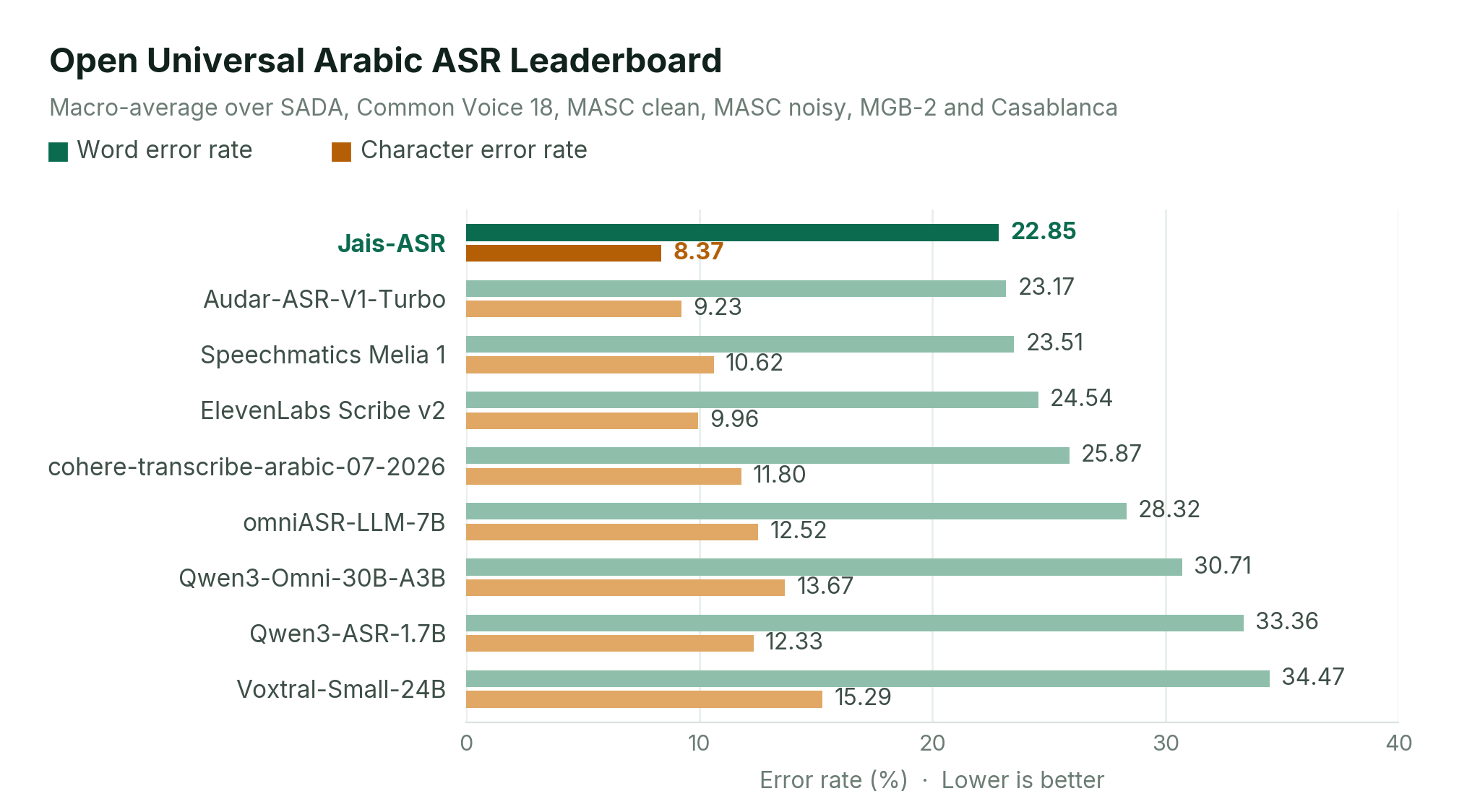
The Open Universal Arabic ASR Leaderboard evaluates models on six public test sets spanning read speech, broadcast media, and conversational dialects, including clean and noisy recordings. In our evaluation using the leaderboard’s protocol, Jais-ASR achieves the best average word error rate among every model currently listed, demonstrating strong overall recognition accuracy across diverse Arabic speech and recording conditions.
Built for Arabic as it is spoken in real life
Broad dialect coverage: Everyday Arabic extends far beyond Modern Standard Arabic, with regional dialects that differ considerably in vocabulary, grammar, and pronunciation. Jais-ASR supports MSA and dialects across 19 countries, reflecting the diversity of spoken Arabic from east to west.
Natural code-switching: Real conversations do not always stay in one language. Jais-ASR is designed for code-switched and multilingual speech, including natural switches between Arabic and English, French, Spanish, or Italian.
Robustness to background noise: Jais-ASR is designed to recognize speech not just in quiet controlled settings but also amid background noise and challenging acoustic environments.
Production-ready, accurate and faithful
Diacritization: Arabic script normally omits short vowels, so words built on the same root often share a written form while differing in pronunciation and meaning. Diacritics resolve this ambiguity: a small set of marks (fatha, damma, kasra, their doubled tanwin forms, sukun, and shadda) indicates a word's pronunciation and grammatical role. Jais-ASR supports diacritization, making transcripts clearer and more useful for reading assistance, language learning, and non-native speakers.
Built-in language identification: Jais-ASR identifies the language and Arabic dialect alongside transcription. These labels can help developers organize multilingual recordings, analyze dialect coverage, and route transcripts to appropriate downstream tools without deploying a separate identification model.
Clean, faithful transcription: Jais-ASR is designed to avoid common transcription failures made by existing systems: memorized boilerplate, repetition loops, and translating speech instead of transcribing it. When there is nothing to transcribe, it returns an [IFM-NoTranscript] tag rather than inventing a sentence. It provides downstream applications an explicit signal instead of misleading text.
State-of-the-art in Arabic speech recognition
The Open Universal Arabic ASR Leaderboard brings together six public test sets: Common Voice 18 for sentence reading in Modern Standard Arabic, MASC clean and noisy for MSA lectures, MGB-2 for broadcast news, SADA for Saudi dialectal broadcast speech, and Casablanca for conversations across eight Arabic dialects. Together, they evaluate recognition across varied speaking styles, dialects, and recording conditions. Evaluated using the leaderboard’s own protocol, Jais-ASR leads overall on both metrics, achieving a 22.85% Word Error Rate (WER) and an 8.37% Character Error Rate (CER) macro-averaged across the six test sets.
Open Universal Arabic ASR Leaderboard
Jais-ASR
Audar-ASR-V1-Turbo
cohere-transcribe-arabic-07-2026
omniASR-LLM-7B
Qwen3-Omni-30B-A3B
Qwen3-ASR-1.7B
Voxtral-Small-24B
Speechmatics Melia 1
ElevenLabs – Scribe v2
Averagemacro-average over the six test sets
22.85 / 8.37
23.17 / 9.23
25.87 / 11.80
28.32 / 12.52
30.71 / 13.67
33.36 / 12.33
34.47 / 15.29
23.51 / 10.62
24.54 / 9.96
Casablanca8 dialects, conversational
46.56 / 18.02
47.02 / 18.75
49.71 / 20.66
56.46 / 23.96
62.55 / 28.53
64.47 / 26.23
66.30 / 30.64
46.41 / 20.41
50.20 / 21.18
Common Voice 18MSA Read Speech
8.56 / 2.70
8.09 / 2.46
5.82 / 1.62
8.75 / 2.71
11.46 / 4.28
16.90 / 5.06
15.25 / 5.54
5.19 / 1.62
8.71 / 3.00
MASC cleanMSA lectures, clean
16.12 / 3.76
16.73 / 5.32
19.60 / 6.45
19.69 / 5.76
21.47 / 5.59
24.37 / 5.72
23.96 / 7.06
16.23 / 5.11
16.91 / 4.97
MASC noisyMSA lectures, noisy
25.44 / 7.51
27.19 / 9.78
27.07 / 10.13
29.29 / 10.66
30.85 / 11.28
34.29 / 10.84
34.43 / 12.22
25.89 / 9.47
27.15 / 9.36
MGB-2MSA broadcast news
9.59 / 3.92
11.08 / 5.64
15.54 / 8.40
14.13 / 7.10
13.09 / 6.20
16.57 / 6.25
16.03 / 7.41
12.61 / 5.88
10.30 / 4.78
SADASaudi dialectal broadcast
30.85 / 14.33
28.92 / 13.40
37.47 / 23.53
41.61 / 24.95
44.82 / 26.11
45.53 / 19.90
50.82 / 28.85
34.74 / 21.21
33.96 / 16.48
Average WER / CER (%) on the Open Universal Arabic ASR Leaderboard, macro-averaged over its six test sets; lower is better. Jais-ASR measured with the leaderboard's evaluation script. Scores for the other models were taken from the leaderboard or measured for ElevenLabs and SpeechMatics.
Designing and training Jais-ASR
Built for everyday Arabic, ready for production
Jais-ASR brings Arabic speech transcription, code-switching support, and language identification into one model, with configurable controls to tailor the output to your application. The model was designed to support the following capabilities:
Transcribe multilingual speech as spoken. Enable code_switch=True to retain English, French, Spanish, or Italian spans in their original script alongside Arabic, useful for interviews, and everyday conversations.
Add diacritics for clearer Arabic pronunciation. Enable diacritics=True to add vowel marks to Arabic transcripts, making them easier to read and supporting language learning. Diacritics and code-switching can be enabled together.
Detect the language and dialect as you transcribe. Each transcript is returned with its recognized language or dialect label, helping you organize recordings and route text to downstream tools without a separate identification model.
Handle non-speech audio explicitly. When audio contains no speech (e.g., music or noise), the model returns [IFM-NoTranscript] with the flag refused=True, rather than hallucinated content. This provides a clear signal that transcription was refused so applications can handle the case separately.
Process multiple recordings at once. Batch transcription supports files with different durations and sample rates.
Jais-ASR is also designed to address several common failure modes we observed in existing Arabic ASR systems. A transcript should capture what was said, and nothing else. However, our audit of existing models on our corpora revealed recurring errors, including YouTube intro and outro boilerplate inserted into unrelated speech, memorized English and Arabic song lyrics, Quranic verses translated into English, English speech translated into Arabic, fluent text hallucinated in response to music or silence, and runaway repetition loops.
To support our design, we construct our data and shape Jais-ASR’s training around three priorities: broad coverage of speech varieties, robustness to challenging recordings, and reducing the limitations and artifacts common to existing ASR models. Built on a Jais-3 language model backbone, it undergoes two stages of supervised training followed by post-training.
Supervised training: first stage
Learning across languages and recording conditions
The first stage of supervised training teaches Jais-ASR to transcribe speech and follow the requested transcription mode. The main data source contains approximately 25,000 hours of audio, and the assembled training mixture includes over 5 million training examples. Reference transcripts are prepared through model-generated transcription, quality checks, and filtering. We place particular emphasis on dialect diversity, aiming to retain regional vocabulary and expressions in the supervision and to represent Arabic as it is spoken across different communities.
The training mixture emphasizes regional varieties of Arabic alongside English, French, Spanish, and Italian. It covers standard transcription, code-switching, and diacritization (Arabic vowel marks). Multilingual speech and code-switching serve related but distinct challenges: transcribing a French recording requires recognizing French, while transcribing an Arabic conversation containing a French phrase requires preserving the language switch within the utterance. Training examples teach the model to render speech according to the requested settings.
We also explicitly train for challenging speech and audio with nothing to transcribe. An in-house noise augmentation pipeline enables our model to recover spoken words from degraded recordings, while non-speech examples teach it to return an explicit no-transcript response for silence, music, or noise without speech. Both are necessary: a model should avoid inventing words when speech is absent without learning to discard speech simply because it is difficult to hear.
Data component
#Examples (approx.)
Target capability
Arabic speech across regional varieties
3.89 million
Transcribe Arabic words and regional expressions in the requested written form.
English, French, Spanish and Italian speech
804,000
Transcribe speech in each Latin language.
Non-speech audio
334,000
Return [IFM-NoTranscript] for silence, music, or noise without speech.
Noise-augmented speech
121,000
Recover spoken words under degraded recording conditions.
These counts refer to training examples: the same recording may appear more than once with different output instructions or added noise.
Supervised training: second stage
Better supervision and focused practice
The second supervised stage uses around 4.8 million training examples, combining revised transcripts, targeted augmentations, and replay examples from earlier training. For revised transcripts, we use multiple models’ transcriptions and audio-based reviews to identify disagreements and refine the supervision, including cases involving omitted speech, unwanted translation, or recurring boilerplate.
Targeted examples give additional practice with short utterances, noisy recordings, and spoken repetitions. Replay examples maintain the broader transcription capabilities represented alongside this focused work, including multilingual speech, code-switching, diacritization, and appropriate no-transcript responses.
Data Component
#Examples (approx.)
Target capability
Revised transcripts
3.03 million
Reduce omitted speech, unwanted translation, and recurring boilerplate.
Targeted augmentations
540,000
Improve transcription of short utterances, noisy recordings, and spoken repetitions.
Replay from earlier training
1.19 million
Maintain multilingual transcription, code-switching, diacritization, and appropriate no-transcript responses.
Post-training
Faithful transcription
Our post-training combines reinforcement learning with targeted preference optimization to improve transcription accuracy, consistency across output modes, and the handling of non-speech audio and spoken repetitions.
Reinforcement learning on generated transcripts
Using Group Relative Policy Optimization (GRPO) with GDPO normalization, we generate multiple candidate responses for each recording and score them against reference transcripts and task-specific criteria. Rewards assess transcription and diacritic accuracy, correct script use, adherence to the requested transcription mode, and appropriate abstention when speech is absent. They also penalize omissions, words or phrases unsupported by the audio, excessively long or incomplete transcripts, and unwarranted inconsistencies across transcription modes for the same recording. The resulting GRPO updates favor higher-scoring responses, while regularization helps preserve the model’s existing capabilities.
Diacritization combines reference-based and acoustic feedback. We reward agreement with the reference transcript vowel marks and use an additional acoustic reward to align vowel choices with the speaker’s pronunciation. Only outputs with sufficient diacritic coverage are eligible for acoustic evaluation.
Adapting FTPO to ASR
We also adapt Final Token Preference Optimization (FTPO) to speech recognition by constructing preference pairs at individual generation steps. Given the audio and the transcript generated so far, training favors a preferred next token over one associated with a specific error, targeting the decision where the model goes wrong.
This approach addresses two failure modes. For missed speech, preference examples favor beginning a transcript when speech is present, while complementary non-speech examples preserve the appropriate no-transcript response. This balances reducing missed speech against the risk of encouraging invented transcripts.
For repetition, we first distinguish genuine spoken repetitions from runaway looping generations. Our detection pipeline uses reference transcripts and corroborating model outputs to estimate how many repetitions the recording supports, together with duration-aware checks for excessively long outputs. Ambiguous cases are excluded from preference training.
When genuine repetition develops into a generated loop, we place the token-level preference at the point where repetition exceeds what the recording supports. Earlier, legitimate repetitions remain unpenalized, and complementary preference pairs protect the model’s ability to continue through them. The preferred continuation can lead into the next spoken words or end the transcript, depending on the recording. This teaches the model to leave an unsupported loop without cutting short speech that genuinely repeats.
Evaluation considers these behaviors together: fewer invented transcripts alongside fewer missed utterances, and less runaway generation alongside faithful transcription of genuine repetitions.
A new standard for evaluating Arabic ASR
What existing benchmarks leave out
The Open Universal Arabic ASR Leaderboard provides a useful comparison across six public test sets. However, its results capture only part of the challenge of recognizing everyday Arabic. We identified three areas where evaluation needs to improve: coverage, scoring, and reference quality.
Broader coverage of dialects and recording conditions
Dialectal coverage is concentrated in SADA’s Saudi recordings and Casablanca’s eight dialects, leaving several regional varieties unrepresented. The sets include both clean and noisy speech, but do not provide a systematic view of performance across dialects, background noise, overlapping speakers, and language switches. This limits what an overall leaderboard score can tell us about performance in different real-world settings.
Scoring that reflects valid Arabic transcription
Some capabilities also require a different scoring approach. Evaluation with diacritics stripped cannot measure whether a model restores them correctly. Code-switched words introduce another issue: an English word may be written in its original script or transliterated into Arabic. When the reference accepts only one form, the other can count as an error even when it represents the spoken word correctly. Evaluating these capabilities requires diacritized references and explicit rules for acceptable spellings.
References that consistently match the audio
An audit we performed identified clips with mismatched audio and references. We used agreement across model outputs to flag potential problems for inspection. The examples below illustrate three types of mismatch: a transcript extending beyond the clip, a reference unrelated to the dialogue, and a transcript assigned to audio with no speech.
Casablanca (Yemeni test clip, 3.4 seconds)
Reference
كم يا نسوان قا ماتين وهم يسعفوهن وقت الولادة، ولا قانسيكي ضوئية بنت محسن، وكاذيه مرة حلمي، اذكوري اذكوري جارتيك اذيه، اشفقي عليه،صاحبتك وحبيبتك، لاقامه تولد، وتعسر، ومالقيناش مركز صحي نسعفه.[music]
What the audio contains
A few words, then music.
A 31-word reference on 3.4 seconds of audio - nine words a second. The segment boundaries do not match the transcript, so the score is against words the clip does not contain.
SADA (test clip)
Reference
ما هي قاعدة هاهاها
What the audio contains
May God forgive him for what he did to that poor girl. Sometimes I want to say God never forgive him for what he did. No, honey, no. No matter what he is your brother…
English film dialogue, against an unrelated four-word Arabic reference.
Common Voice 18 (Arabic test clip)
Reference
وَأَنِ اعْبُدُونِي هَذَا صِرَاطٌ مُسْتَقِيمٌ
What the audio contains
No speech. The clip has nothing to transcribe.
A Quran verse as the reference for a clip with no speech in it.
Beyond existing benchmarking
We developed an internal Arabic Speech Benchmark to evaluate Arabic recognition across dialects, language switches, and recording conditions within a single framework. The latest version contains 2,500 clips, with references checked by our team, and covers:
MSA and dialects from 19 Arab countries. Recordings include dialectal speech both with and without code-switching with other languages.
Flexible scoring for code-switched words. References accept either the original script or an Arabic transliteration, using the same scoring rules for every model.
Diacritized MSA. A fully diacritized MSA subset supports evaluation with vowel marks retained or removed.
Varied recording conditions. Clips span studio and street recordings, different lengths, and labelled difficulty levels. These include very noisy recordings, identified through speech intelligibility estimates and listening checks.
Results on the current benchmark:
Jais-ASR ranks first on both metrics among the seven models evaluated, achieving 33.3% and 15.2%, respectively, and outperforming the two other open models and all four commercial APIs.
OPEN MODELS
CLOSED-SOURCE APIS
Jais-ASR
Audar-ASR-V1-Turbo
Cohere-transcribe-arabic-07-2026
HUMAIN Voice
Speechmatics Melia 1
Deepgram Nova-3
ElevenLabs Scribe v2
All clipsn = 2,500
33.3 / 15.2
44.7 / 23.3
42.8 / 25.2
36.0 / 20.8
36.2 / 19.6
44.8 / 22.7
34.8 / 15.8
Modern Standard Arabicn = 300
6.4 / 3.0
13.3 / 7.9
31.8 / 23.2
7.2 / 3.7
8.8 / 5.5
23.0 / 9.7
8.1 / 4.9
Dialects, no code-switchingn = 1,204
35.1 / 14.9
45.4 / 21.2
41.7 / 22.4
35.2 / 17.3
38.1 / 18.5
45.3 / 20.6
36.4 / 15.7
Code-switchedn = 1,072
35.4 / 17.4
48.8 / 28.1
45.9 / 28.4
41.2 / 26.9
38.5 / 23.1
47.8 / 26.9
37.1 / 18.0
Heavy code-switchingn = 209
40.5 / 22.6
57.5 / 37.5
54.0 / 37.1
53.3 / 39.7
44.3 / 30.1
55.8 / 36.5
41.4 / 21.3
Very noisyn = 171
55.6 / 31.4
69.6 / 46.8
62.9 / 43.1
54.4 / 37.2
55.7 / 35.2
65.0 / 43.5
55.1 / 31.7
Controlled repetitionsn = 200, separate subset
38.3 / 17.7
56.8 / 38.1
80.8 / 69.5
38.5 / 21.0
40.4 / 18.1
49.8 / 25.2
41.8 / 19.6
Results on the latest version of our internalArabic Speech Benchmark. WER / CER (%), pooled over clips, diacritics stripped, code-switched words accepted in either written form. Jais-ASR in code-switch mode; Audar with its language tag (its best configuration). HUMAIN Voice (Bayan), Speechmatics Melia 1, Deepgram Nova-3 (Arabic model) and ElevenLabs Scribe v2 run through their public APIs on the same clips. Every system was run in its best configuration for Arabic, chosen by measurement rather than by default. The rows overlap: 76 MSA clips contain a code-switched span and are counted under both Modern Standard Arabic and Code-switched (300 + 1,204 + 1,072 − 76 = 2,500). Heavy code-switching is a subset of Code-switched, and the 171 very noisy clips are drawn from all of these rows. Controlled repetitions is a separate 200-clip set, outside the 2,500.
Jais-ASR substantially outperforms the other open models evaluated, reducing overall WER by 9.5 percentage points against Cohere and 11.4 against Audar. It also outperforms all four commercial APIs overall, with margins over ElevenLabs Scribe v2, HUMAIN Voice, and Speechmatics Melia 1 of 1.5, 2.7, and 2.9 percentage points, respectively.
The lead is also visible at the character level, with larger CER margins against several competitors. Against HUMAIN Voice, Jais-ASR lowers overall WER by 2.7 percentage points and CER by 5.6 percentage points; against Speechmatics, the reductions are 2.9 and 4.4 points, respectively; against Cohere, 9.5 and 10.0 points. WER counts a whole word as incorrect even when only one letter differs, while CER measures differences character by character. These results are consistent with Jais-ASR’s tendency to transcribe faithfully what it hears: even where a word does not match the reference exactly, more of its written form is preserved. This matters for Arabic dialects, where spelling and word-boundary conventions can vary.
This strength extends across MSA, dialectal speech without code-switching, and code-switched speech, with Jais-ASR achieving the lowest WER and CER in all three categories. On code-switched recordings, it achieves 35.4% WER, ahead of ElevenLabs at 37.1% and the other open models at 45.9–48.8%.
The gap to the open models widens further on heavy code-switching: Jais-ASR achieves 40.5% WER, compared with 54.0% for Cohere and 57.5% for Audar, a reduction of 13.5–17.0 percentage points. It retains the lowest WER among the commercial APIs as well, with ElevenLabs closest at 41.4%.
Hearing the difference
Fourteen clips from the benchmark, spanning its dimensions. Ground truth is shown in mixed-script form. Per-clip WER is computed according to the benchmark protocol and capped at 100% only for display. Pick the clips and the systems you want to compare.
MSA
Modern Standard Arabic, narration
Modern Standard Arabic · 13 s · difficulty: medium · code-switch: none
نوعين في ميتابوليك وفي الاسبراتوري يعني اوكي ميتابوليك ميتابوليك ميتابوليك اسيدوس
EGYPT
Egyptian Arabic
Egypt · 3 s · difficulty: medium · code-switch: none
Ground truth
لو إنت النهاردة نزلت سوق العبور تتمشى، وتسأل على كيلو البطاطس بكام؟
Jais-ASRcode_switch=TrueWER 0.0%
لو انت النهاردة نزلت سوق العبور تتمشى وتسأل على كيلو البطاطس بكام
Jais-ASRno code_switchWER 0.0%
لو انت النهاردة نزلت سوق العبور تتمشى وتسأل على كيلو البطاطس بكام
HUMAIN VoiceWER 8.3%
لو أنت النهارده نزلت سوق العبور تتمشى وتسأل على كيلو البطاطس بكام
Speechmatics Melia 1WER 16.7%
لو انت النهاردة نزلت سوق العبور تتمشى، وتسأل على كلمة البطاطس،
ElevenLabs Scribe v2WER 8.3%
لو انت النهاردة نزلت سوق العبور تتمشى وتسأل على كيلو البطاطس بت
Audar-ASR-V1-TurboWER 41.7%
لو انت النهارده انزل تسوق العبور تتمشى وتسأل على كده البطاطس بكيف
Cohere-transcribe-arabic-07-2026WER 50.0%
لو انت مارضى نزلت شغل امك تتمشى وتسأل على كلمة تتصبكى
Deepgram Nova-3WER 8.3%
لو أنت النهاردة نزلت سوق العبور تتمشى وتسأل على كيلو البطاطس
GULF
Emirati Arabic
United Arab Emirates · 12 s · difficulty: hard · code-switch: none
Ground truth
ثلاثين مليون بس؟ هذي الأرض من غير المزروع فيها، تسوى أكثر من كذي. وتقولون السالفة ما فيها شي. رد عليه يبا، تعبت وأنا أعيد وأزيد فالحكي. رد على العم بو صالح، مو راضي يبلعها مو راضي.
Jais-ASRcode_switch=TrueWER 19.4%
ثلاثين مليون بس. هذي الأرض من غير المزروع فيها تسوى أكثر من كذي. وتقولون السّالفة ما فيها شي. رد علي يوبا تعبت وأنا أعيد وأزيد في الحكي. يرد على أبو صالح مو راضي يبلعها مو راضي.
Jais-ASRno code_switchWER 16.7%
ثلاثين مليون بس. هذي الأرض من غير المزروع فيها تسوى أكثر من كذي. وتقولون السالفة ما فيها شي. رد علي يبا تعبت وأنا أعيد وأزيد في الحكي. يرد على أبو صالح مو راضي يبلعها مو راضي.
HUMAIN VoiceWER 22.2%
ثلاثين مليون بس هذه الأرض من غير المزروع فيها تسوى أكثر من كده وتقولون السالفة ما فيها شيء رد علي يوبا تعبت وأنا أعيد وأزيد الحكي رد على عم أبو صالح مو راضي يبلعها مو راضي
ElevenLabs Scribe v2WER 27.8%
ثلاثين مليون بس. هذي الأرض من غير المزروع فيها تسوى أكثر من كذيه. وتقولون السالفة ما فيها شي. ارد عليه يا بابا تعبت وأنا أعيد وأزيد في الحكي. يرد على أبو صالح مو راضي بلاها مو راضي.
Speechmatics Melia 1WER 36.1%
30 مليون بس هذه الأرض من غير المزروع فيها تسوى أكثر من كذي وتقولوا لي السالفة ما فيها شي رد علي يبه، تعبت هون أعيد وزير في الحكي، يرد على أبو صالح مو راضي يبلعها، مو راضي.
Audar-ASR-V1-TurboWER 25.0%
ثلاثين مليون بس هذه الأرض من غير المزروع فيها تسوى أكثر من كده وتقولون السلفة ما فيها شيء . رد عليه يبا تعبت وأنا أعيد وأزيد في الحكي رد على أنبصالح مو راضي يبلعها مو راضي
Cohere-transcribe-arabic-07-2026WER 63.9%
رد علي يبا تعبت وانا اعيد وازيد في الحكي رد علي ابو صالح مو راضي يبلعها مو راضي
Deepgram Nova-3WER 33.3%
ثلاثين مليون بس هذه الارض من غير المزروع فيها تسوى اكثر من كذي وتقولولي السالفه ما فيها شيء رد علي يا تعبت وانا اعيد وازيد في الحكي يرد علي عم ابو صالح مو راضي بالعهم مو راضي
LEVANT
Jordanian Arabic
Jordan · 11 s · difficulty: easy · code-switch: none
Ground truth
نفسي أشوف جلالة الملك وأقبله، وبشد على إيده، وبهنيه. نعم. على نعمة الأمن والأمان. والله يخليلنا إياه، ويطولنا بعمره.
Jais-ASRcode_switch=TrueWER 5.3%
نفسي أشوف جلالة الملك وأقبله وبشد على إيده وبهنيه نعم على نعمة الأمن والأمان والله يخلينا إياه ويطولنا بعمره
Jais-ASRno code_switchWER 15.8%
نفسي أشوف جلالة الملك وأقبله وبشد على إيده وبهنيه على نعمة الأمن والأمان والله يخلينا إياه وطولنا بعمره
HUMAIN VoiceWER 21.1%
نفسي اشوف جلاله الملك واقبله وبشد على ايده وبهنيه على نعمه الامن والامان والله يخليلنا ياه ويطولنا بعمره
ElevenLabs Scribe v2WER 36.8%
نفسي أشوف جلالة الملك وأقبله وبشد على يده وبهنيه على نعمة الأمن والأمان. الله يخلي لنا إياه طولنا بعمر.
Speechmatics Melia 1WER 47.4%
نفسي أرى جلالة الملك وأقبله، وأشد على يده وأهنيه على نعمة الأمن والأمان، والله يخلي لنا إياه وطولنا بعمر
Audar-ASR-V1-TurboWER 31.6%
نفسي أشوف جلالة الملك وأقبله وبشد على إيده وب# وبهنيه على نعمة الأمن والأمان و الله يخلينا إياه وطولنا بعمره
Cohere-transcribe-arabic-07-2026WER 15.8%
نفسي أشوف جلالة الملك وأقبله وبشد على أيده وبأهنيه على نعمة الأمن والأمان والله يخليلنا إياه طولنا بعمره
Deepgram Nova-3WER 26.3%
نفسي اشوف جلاله الملك واقبله وبشد علي ايده وبهنيه علي نعمه الامن والامان والله يخليلنا اياه وطولنا
GULF
Saudi Arabic
Saudi Arabia · 11 s · difficulty: medium · code-switch: none
Ground truth
خمس مرات يا حليت سألتك ونت ما تجاوبني. وأنا رجال صبري ابتدى ينفد. إذا ما جاوبتني الحين... ليه شردت؟ بحطها فراسك.
Jais-ASRcode_switch=TrueWER 14.3%
خمس مرات يا حليت سألتك وانت ما تجاوبني وانا رجال صبري ابتدى ينفد اذا ما جاوبتني الحين ليه شردت بحطها في راسك
Jais-ASRno code_switchWER 14.3%
خمس مرات يا حليت سألتك وانت ما تجاوبني وانا رجال صبري ابتدى ينفد اذا ما جاوبتني الحين ليه شردت بحطها في راسك
HUMAIN VoiceWER 14.3%
خمس مرات يا حليت سألتك وأنت ما تجاوبني وأنا رجال صبري ابتدى ينفد إذا ما جاوبتني الحين ليه شردت بحطها في راسك
ElevenLabs Scribe v2WER 23.8%
خمس مرات يا حليت سألتك وانت ما تجاوبني. وأنا رجال صبري ابتدى ينفد. إذا ما جاوبتني الحين ليه شرط بحطه في راسك
Speechmatics Melia 1WER 19.0%
خمس مرات يا حليت سألتك وانت ما تجاوبني. وانا رجال صبري ابتدا ينفد. اذا ما جاوبتني الحين ليه شردت بحطها في راسك.
Audar-ASR-V1-TurboWER 23.8%
خمس مرات يا حليت سألتك وانت ما تجاوبني وأنا رجال صبري ابتدى ينفذ إذا ما جاوبتني الحين ليه شرطت بحطها في راسك
Cohere-transcribe-arabic-07-2026WER 23.8%
خمس مرات يا حليلت سألتك وأنت ما تجاوبني.. وأنا رجال صبرك ابتدي ينفد إذا ما جاوبتني الحين ليه شردت بحطها في راسك!
Deepgram Nova-3WER 23.8%
خمس مرات يا حليت سالتك وانت ما تجاوبني وانا رجال صبري ابتدا ينفد اذا ما جاوبتني الحين ليه شردت بحطه في راسك
GULF
Kuwaiti Arabic
Kuwait · 12 s · difficulty: medium · 4.0 words a second
Ground truth
بس يعني حتى بالمسلسلات تنحط الأول عندنا بعدين بال plus. حبيبي إحنا الأصل، عطني ال menu يالا، يالا فارقنا يالا. أروح الحين إثبات حالة، أروح المخفر أسجل إثبات حالة. ف يالا اللي تبي تسويه سوه يالا عاد يالا، توكل على الله. إن ما عشيت حمايتك المخفر... والله صدق تمام ما آخذهم.
Jais-ASRcode_switch=TrueWER 59.2%
بس يعني حتى بالمسلسلات تنحط الأول عندنا بعدين بالplus حبيبي إحنا الأصل عطني عطني المنيو يلا يلا فرجوا لنا كيف يثبت حاله يروح المغفرة يسجل لا يلا اللي تبي تسويه سوي الله عاد الله حبيبي المغفرة توكل على الله والله صوتهم ما
Jais-ASRno code_switchWER 61.2%
بس يعني حتى بالمسلسلات تنحط الأول عندنا بعدين بلس حبيبي إحنا الأصل عطني عطني المنيو يلا يلا فرجوا لنا هذا يثبت حاله يروح المغفرة يسجل لا يلا اللي تبي تسويه سوي الله عاد الله حبيبي المغفرة توكل على الله والله صوتهم ما باخذهم
HUMAIN VoiceWER 65.3%
يعني حتى بالمسلسلات تنحط الأول عندنا بعدين بالبلاص حبيبي احنا الأصل عطني عطني عطني المنيو يلا يلا إللي تبي تسويه سويه يلا توكل على الله باخذهم
ElevenLabs Scribe v2WER 69.4%
يعني حتى بالمسلسلات ينحط الأول عندنا بعدين بالبلس. حبيبي إحنا الأصل. عطي عطي عطني المنيو يلا يلا. ميثاق حاله بيروح المفرقة يسجل. يلا اللي تبي تسويه سواه. يلا عيش مهاميرك بالمفرقة. توكل على الله. ما صارت أموال ماخذها.
Speechmatics Melia 1WER 67.3%
يعني حتى بالمسلسلات تنحط الاول عندنا بعدين بالبلاص حبيبي احنا الاصل عطني عطني منو يلا يلا يلا خرجوا. حبي ثبات حاله بروح المغفرة تسجل فيلا اللي تبي تسويه سويلا ححامينك المغفرة. الله تكل على الله. مواصلات هذ ماخذهم.
Audar-ASR-V1-TurboWER 65.3%
يعني حتى بالمسلسلات تنحط الأول عندنا بعدين بنبلص حبيبي إحنا الأصل عطني عطني المينيو يلا يلا برجولتك ... يلا يلا اللي تبي تسويه سويه يلا عاد الله يسلمك ... عشان مهامينك المخفر تتوكل على الله ... الله يسامحك ما أخذهم
Cohere-transcribe-arabic-07-2026WER 71.4%
###حتى بالمسلسلات نحط الأول عندنا بعدين بالبلس...حبيبي احنا الأصل عطني عطني المنيو يلا يلا فرجي يلا يلا الي تبي تسويه سويه يلا حلو توكل على الله...
ورد بس. لأ، ما في ولا وردة، ما فيك تبيع هون هيدا محل هون، ما فيك تضلك... ميت مرة قلتلك ما بقى توقف هون تبيع ورد. ورد، please. لأ، بلا please بلا بلوط عمو، روح بيع ورد غير هون، الله معك. ما بقى تجي لهون.
Jais-ASRcode_switch=TrueWER 20.0%
ورد بس. ما في ولا وردي ما فيك تبيع هون هون قدام محل هون ما فيك تضل مئة مرة قلتلك ما بقى توقف هون تبيع ورد. ورد. please. لا بلا please بلا بلوط. عمو روح روح بيع ورد غير هون الله معك الله معك. ما بقى تجي لهون.
Jais-ASRno code_switchWER 20.0%
ورد بس ما في ولا وردي ما فيك تبيع هون هون قدام محل هون ما فيك تضل مئة مرة قلتلك ما بقى توقف هون تبيع ورد ورد بليز لا بلا بليز بلا بلوط عمو روح روح بيع ورد غير هون الله معك الله معك ما بقى تجي لهون
HUMAIN VoiceWER 22.2%
ما في ولا وردة ما فيك تبيع هون هون محل هون ما فيك تضلك مية مرة قلتلك ما بقى توقف هون تبيع ورد لا بلا بليز بلا بلوط عمو روح روح بيع ورد غير هون الله معك الله معك ما بقى تجي لهون
ElevenLabs Scribe v2WER 35.6%
ورد بس. ما في ولا ورد. ما فيك تبيع هون. هون قد المحل هون. ما فيك تضلك مية مرة قلت لك ما بتوقف هون. بيع ورد. ورد بليز. لا بلا بليز بلا بلوط. عمو روح روح بيع ورد غير هون. الله معك الله معك. ما بعتجي لهون.
Speechmatics Melia 1WER 28.9%
وردة بس. ما فيه ولا وردة. ما فيك تبيع هون. هون الأداة محل هون. ما فيك تضلك مية مرة قلت لك ما بقى توقف هون تبيع ورد. ورد بليز. لا بلا بليز بلا بلوط. عمو روح روح بيع ورد غير هون. الله معك. الله معك. ششششششششششششششششششششششششششششششششششششششششششششششششششششششششششششششششششششششششششششششششششششششششششششششششششششششششششششششششششششششش
Audar-ASR-V1-TurboWER 28.9%
لا ما في ولا ورد ما فيك تبيع هون هون ده محل هون ما فيك تضلك ميت مرة أقول لك ما بقى تقف هون تبيع ورد ... ورد بليز ... لا بلا بليز بلا بلوت عمو روح روح بيع ورد غير هون الله معك الله معك ش ما بقى تجي لهون
Cohere-transcribe-arabic-07-2026WER 42.2%
ورد وبس مافي ولا وردة مافيك تبيع هون هون هدا محل هون مافيك تضلك مية مرة قلتلك مابقا توقف هون تبيع ورد ورد بليز لا بلا بليز بلا بلوط عمو روح روح بيع ورد غير هون الله معك الله معك شششششش مابقا تيجي لهون
Deepgram Nova-3WER 31.1%
ما في ولا ورده ما فيك تبيع هون هول الاداء محل هون ما فيك تضلك مئه مره قلتلك ما بق توقف هون تبيع ورد ورد بليز لا بلا بليز بلا بلوط عمو روح روح بيع ورد غير هون الله معك الله معك بق تيجي لهون
REPETITION STRESS
Repeated utterance
Egypt · 13 s · code-switch: none
Reference (spoken 3x, 1.0 s gap)
يا رب، ألحق بقى أقوم قبل ما يغمى عليا جنبك. يا رب، ألحق بقى أقوم قبل ما يغمى عليا جنبك. يا رب، ألحق بقى أقوم قبل ما يغمى عليا جنبك.
Jais-ASRcode_switch=TrueWER 10.0%
يا رب الحق بقى قوم قبل ما يغمى عليا جنبك يا رب الحق بقى قوم قبل ما يغمى عليا جنبك يا رب الحق بقى قوم قبل ما يغمى عليا جنبك
Jais-ASRno code_switchWER 10.0%
يا رب الحق بقى قوم قبل ما يغمى عليا جنبك يا رب الحق بقى قوم قبل ما يغمى عليا جنبك يا رب الحق بقى قوم قبل ما يغمى عليا جنبك
Speechmatics Melia 1WER 10.0%
يا رب الحق بقى قوم قبل ما يغمى عليا جنبك. يا رب الحق بقى قوم قبل ما يغمى عليا جنبك. يا رب الحق بقى قوم قبل ما يغمى عليا جنبك.
ElevenLabs Scribe v2WER 20.0%
يا رب. الحق بقى قوم قبل ما يغمى عليا جنبيك. يا رب. الحق بقى قوم قبل ما يغمى عليا جنبيك. يا رب. الحق بقى قوم قبل ما يغمى عليا جنبيك
The results above are on the current version of the benchmark, 2,500 clips. We plan on improving and expanding it so that the next generation of Arabic speech models is measured on the speech people actually produce.
Get started with Jais-ASR today
Jais-ASR is available now on Hugging Face at IFM/Jais-ASR, with a transformers quick start and a vLLM plugin. Weights are 11.4 GB in bf16; plan on roughly 12 GB of GPU memory.
With Transformers
import soundfile as sfimport torchfrom transformers import AutoModelForCausalLM, AutoProcessormodel_id = "IFM/Jais-ASR"processor = AutoProcessor.from_pretrained(model_id, trust_remote_code=True)processor.tokenizer.padding_side = "left"model = AutoModelForCausalLM.from_pretrained( model_id, trust_remote_code=True, device_map="auto", dtype=torch.bfloat16,).eval()paths = ["speech_1.wav", "speech_2.wav"]audio = [sf.read(path, dtype="float32") for path in paths]waveforms = [waveform for waveform, _ in audio]sample_rates = [sample_rate for _, sample_rate in audio]prompt = processor.tokenizer.apply_chat_template( [{"role": "user", "content": [{"type": "audio"}]}], tokenize=False, add_generation_prompt=True, # diacritics=True, # Add Arabic vowel marks. # code_switch=True, # Keep other languages in their original script.)inputs = processor( text=[prompt] * len(waveforms), audio=waveforms, sampling_rate=sample_rates, padding=True, return_tensors="pt",).to(model.device)with torch.inference_mode(): output = model.generate( **inputs, do_sample=False, max_new_tokens=256, # Set the target language to override automatic detection. # language="EG", )# `language` contains a language or dialect label, such as `msa`, `EG`, or `en`.# When the model emits `[IFM-NoTranscript]`, postprocessing sets `refused=True`# and returns an empty transcript. Uncomment either prompt option above to# request diacritics or code-switching; both can be enabled together.transcripts = processor.post_process_transcription( output, input_lengths=inputs["input_ids"].shape[1],)for path, result in zip(paths, transcripts): print(path, { "text": result.text, "language": result.language, "refused": result.refused, })
As a vLLM Plugin
pip install 'vllm==0.23.0' 'transformers==5.5.4' accelerate soundfile soxrpip install ./vllm_plugin # shipped in the model repovllm serve IFM/Jais-ASR --trust-remote-code --reasoning-parser jais_asr_tag --max-model-len 2048curl http://localhost:8000/v1/audio/transcriptions -F file=@clip.wav -F model=IFM/Jais-ASR
Full results
Finally, we provide a more detailed set of results across several complementary evaluation settings. The results show that Jais-ASR performs strongly on Emirati Arabic–English code-switched speech using Mixat, remains competitive on English-only speech across the Open ASR Leaderboard English suite, delivers consistently strong performance across Arabic dialects, maintains greater robustness under noisy conditions, and provides effective built-in dialect identification.
EMIRATI CODE-SWITCHED SPEECH (MIXAT)
Jais-ASR
Audar-ASR-V1-Turbo (reported)
Cohere-transcribe-arabic-07-2026
WER %
17.8
19.4
25.7
CER %
6.0
7.3
15.0
Mixat test set (1,585 Emirati clips with Arabic-English code-switching). Jais-ASR in code-switch mode and Cohere scored under the same pipeline; Audar as reported on its model card.
ENGLISH SPEECH
Jais-ASR
Audar-ASR-V1-Turbo
cohere-transcribe-arabic-07-2026
Average
7.63 / 4.90
14.34 / 13.14
5.29 / 3.27
English, Open ASR Leaderboard suite (AMI, Earnings-22, GigaSpeech, LibriSpeech clean/other, SPGISpeech, VoxPopuli). Average WER / CER (%).
DIALECTS
Jais-ASR
HUMAIN Voice
ElevenLabs Scribe v2
Speechmatics Melia 1
Deepgram Nova-3
Audar-ASR-V1-Turbo
Cohere-transcribe-arabic-07-2026
Macro average
33.0 / 15.2
35.5 / 20.5
34.3 / 15.7
36.0 / 19.8
44.7 / 22.7
44.5 / 23.3
42.4 / 25.0
United Arab Emirates
31.3 / 12.9
26.9 / 10.9
30.5 / 12.8
34.3 / 18.1
41.0 / 17.5
39.6 / 18.7
38.0 / 21.0
Bahrain
16.2 / 6.1
18.7 / 6.5
23.2 / 9.5
21.2 / 10.9
26.4 / 9.4
24.4 / 8.7
16.4 / 6.6
Algeria
39.1 / 18.0
51.1 / 35.9
43.7 / 19.2
45.2 / 23.2
52.1 / 28.1
56.8 / 30.6
55.5 / 32.0
Egypt
22.9 / 9.3
22.5 / 10.2
21.7 / 8.7
24.1 / 13.1
32.7 / 15.3
32.8 / 15.3
33.2 / 20.5
Iraq
40.9 / 18.7
39.7 / 22.9
38.6 / 18.1
40.3 / 19.9
52.7 / 27.7
52.8 / 28.3
49.7 / 30.3
Jordan
27.5 / 12.5
34.6 / 22.3
29.3 / 12.8
30.7 / 18.5
40.7 / 21.2
36.1 / 17.5
38.1 / 22.0
Kuwait
27.7 / 12.4
27.3 / 14.0
28.6 / 13.5
29.9 / 17.1
37.8 / 18.0
37.3 / 19.6
37.4 / 22.7
Lebanon
48.6 / 26.1
44.1 / 29.7
43.7 / 23.7
45.7 / 27.7
57.7 / 36.3
58.8 / 35.5
53.2 / 33.7
Libya
34.5 / 15.2
35.4 / 21.4
36.7 / 15.7
38.8 / 20.6
47.9 / 24.5
45.1 / 24.3
43.9 / 24.7
Morocco
36.5 / 15.0
56.0 / 36.6
42.1 / 15.6
47.3 / 22.5
55.2 / 26.8
57.0 / 26.6
46.5 / 22.2
Mauritania
45.6 / 23.7
48.8 / 33.7
47.3 / 25.6
48.3 / 26.5
57.8 / 33.2
56.2 / 34.9
56.6 / 34.7
Oman
25.6 / 11.2
25.9 / 11.4
27.5 / 11.2
30.9 / 14.1
37.9 / 17.1
33.3 / 15.2
33.4 / 18.5
Palestine
38.6 / 19.2
40.9 / 26.0
36.9 / 19.0
40.0 / 25.9
47.5 / 25.6
51.9 / 29.2
45.1 / 27.3
Qatar
31.3 / 15.5
32.3 / 18.0
33.5 / 17.0
35.2 / 20.3
45.0 / 24.6
44.4 / 28.3
41.0 / 24.4
Saudi Arabia
33.6 / 18.4
33.7 / 22.2
31.7 / 16.7
37.1 / 30.5
43.7 / 26.7
47.0 / 29.9
47.0 / 32.9
Sudan
33.6 / 14.3
35.3 / 17.6
32.2 / 14.0
35.4 / 18.6
42.5 / 18.8
42.4 / 19.3
43.2 / 25.0
Syria
26.9 / 11.7
26.9 / 15.1
28.9 / 12.7
27.8 / 14.5
37.7 / 18.4
36.7 / 17.6
37.6 / 23.2
Tunisia
30.3 / 10.8
38.3 / 14.4
39.1 / 14.5
33.2 / 11.2
45.4 / 17.8
48.5 / 20.1
38.2 / 19.0
Yemen
36.9 / 17.5
35.7 / 20.3
35.8 / 17.1
39.5 / 23.1
47.6 / 25.2
44.9 / 23.4
52.3 / 34.5
Internal Arabic Speech Benchmark, 2,500 clips. WER / CER (%) per country, pooled over the clips of that country; the macro average weights all 19 countries equally. Bold marks the best WER in the row.
NOISE ROBUSTNESS
Jais-ASR
Cohere-transcribe-arabic-07-2026
Audar-ASR-V1-Turbo
WER/CER (%)
55.6 / 31.4
62.9 / 43.1
69.6 / 46.8
WER / CER (%) on the 171 very-noisy recordings within the 2,500-clip of our Internal Arabic Speech Benchmark. Samples were selected using SQUIM-estimated STOI—a score of how understandable speech is—and listening checks, with scores of approximately 0.7911 or lower. These are the same 171 clips, runs and scoring protocol as the Very noisy row of the benchmark results table above (WER / CER pooled over clips, diacritics stripped, code-switched words accepted in either written form).
DIALECT IDENTIFICATION
Precision
Recall
F1
Macro average (20 classes)
72.5
68.1
65.4
Morocco
81.7
91.9
86.5
Sudan
94.8
74.1
83.2
Jordan
87.7
77.9
82.5
Yemen
77.2
86.2
81.5
Egypt
73.5
90.5
81.1
Palestine
85.0
76.9
80.8
Lebanon
75.2
84.1
79.4
Saudi Arabia
81.0
77.5
79.2
Syria
79.6
76.2
77.9
Iraq
85.1
69.4
76.4
Mauritania
84.3
69.7
76.3
Algeria
52.7
84.7
65.0
Libya
52.4
83.9
64.5
Oman
75.8
53.3
62.6
UAE
56.7
65.7
60.9
Qatar
65.4
49.6
56.4
Kuwait
50.1
59.9
54.6
Tunisia
99.7
17.0
29.0
MSA
14.2
70.2
23.7
Bahrain
76.9
3.1
5.9
Dialect identification from the language tag, ADI-20 benchmark. Precision / Recall / F1 (%).