


Today we are releasing Jais 3, six open Arabic-centric models from 0.9B to 375B parameters, built on K2 Horizon, our open model family.
Most Arabic models are judged on whether they can reply in fluent and accurate Arabic. We wanted a model that also does the work: read an Arabic contract, update a spreadsheet, call a tool and hand back the finished result. And it should do so in the Arabic language its users actually speak: Modern Standard Arabic, dialects such as Emirati and Egyptian, or Arabizi. We built it for people and organizations across the Middle East and North Africa, and for Arabic speakers everywhere.
Jais 3 leads or matches the best open models on Arabic at every size, and at 375B it competes with frontier closed models. It also works as an agent: at 7B and 3.7B it tops every agentic benchmark we ran against models of its size.
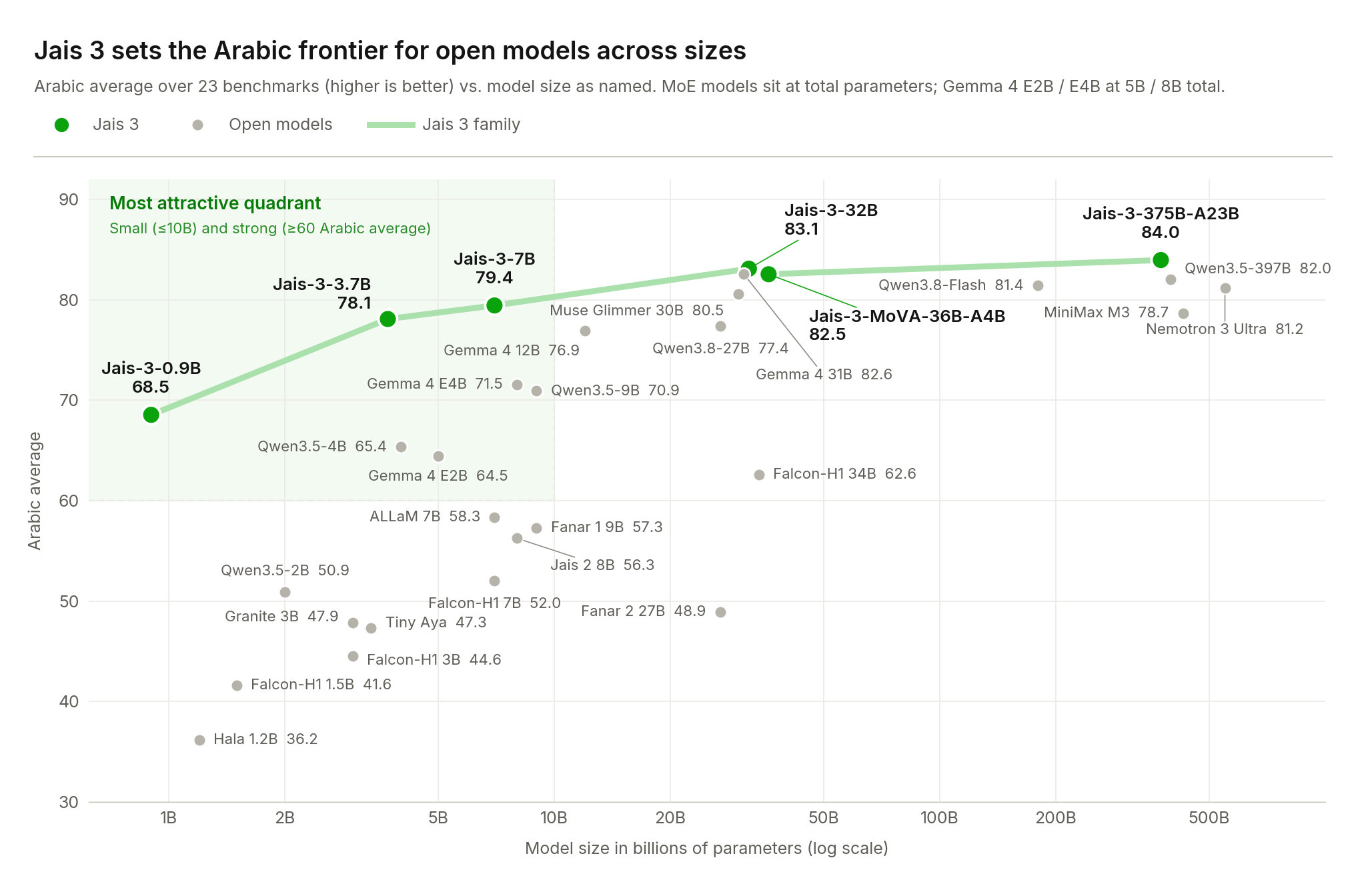
- Built to act, not just chat. Jais 3 is trained to work as an agent: it plans multi-step tasks, calls tools, edits Arabic documents and searches the web, while talking to the user in Arabic. On our agentic average, the 7B beats Gemma 4 31B and Muse Glimmer 30B, open models more than four times its size, and the 375B beats every larger open model we tested.
- One family, from phone to data center. Six sizes from 0.9B to 375B share one training recipe, so Jais 3 can run on a phone, a laptop, a single server or a full GPU node.
- Long context. A 512K-token context window (128K for the 0.9B), room for hundreds of pages of Arabic text or a long multi-step agent run.
- Follows Arabic instructions closely. It keeps to the format, length and constraints you set, with the top Arabic instruction-following score of any open model we compared, at every size.
- Open weights, data and checkpoints. The final weights for all six models, checkpoints from every training stage, a sample of the training data, configs, recipes, training logs, and the audited Arabic benchmarks with our evaluation code. Models and code are released under Apache 2.0.
What Jais 3 can do
What you can use Jais 3 for today:
- Works inside your agent. Plug Jais 3 into your agent harness and it plans multi-step work, calls tools and MCP servers, runs terminal commands and searches the web, while chatting with the user in Arabic throughout.
- Reads and writes real files. Give it file tools and it works directly on Arabic PDFs, PowerPoint decks and Excel sheets, editing them or producing new ones.
- Knows the dialects and the culture. Emirati and Egyptian Arabic, poetry, cuisine and Islamic knowledge are all tested in our evaluation suite, and dialects, poetry and Islamic Q&A each have their own training data.
- Takes spoken instructions. Paired with Jais-ASR, our speech recognition model, Jais 3 can take spoken instructions in Arabic or English and carry them out as an agent, as in the demo below.
The family: six sizes, from edge devices to a full GPU node
The smallest model, 0.9B, is meant for phones and edge devices; the largest, 375B-A23B, needs a full 8-GPU node. All six share one training recipe, so you can pick the size that fits your hardware and budget.
Performance: where Jais 3 leads, size by size
We evaluated Jais 3 on two fronts, Arabic and agentic tasks, and ran the competing models ourselves with the same harness. Arabic results are grouped into three domains and ten subdomains, defined with the full tables at the end. The agentic benchmarks use English prompts, except Arabic agentic search (GAIA v2) and our Arabic file-processing benchmark, which run in Arabic.
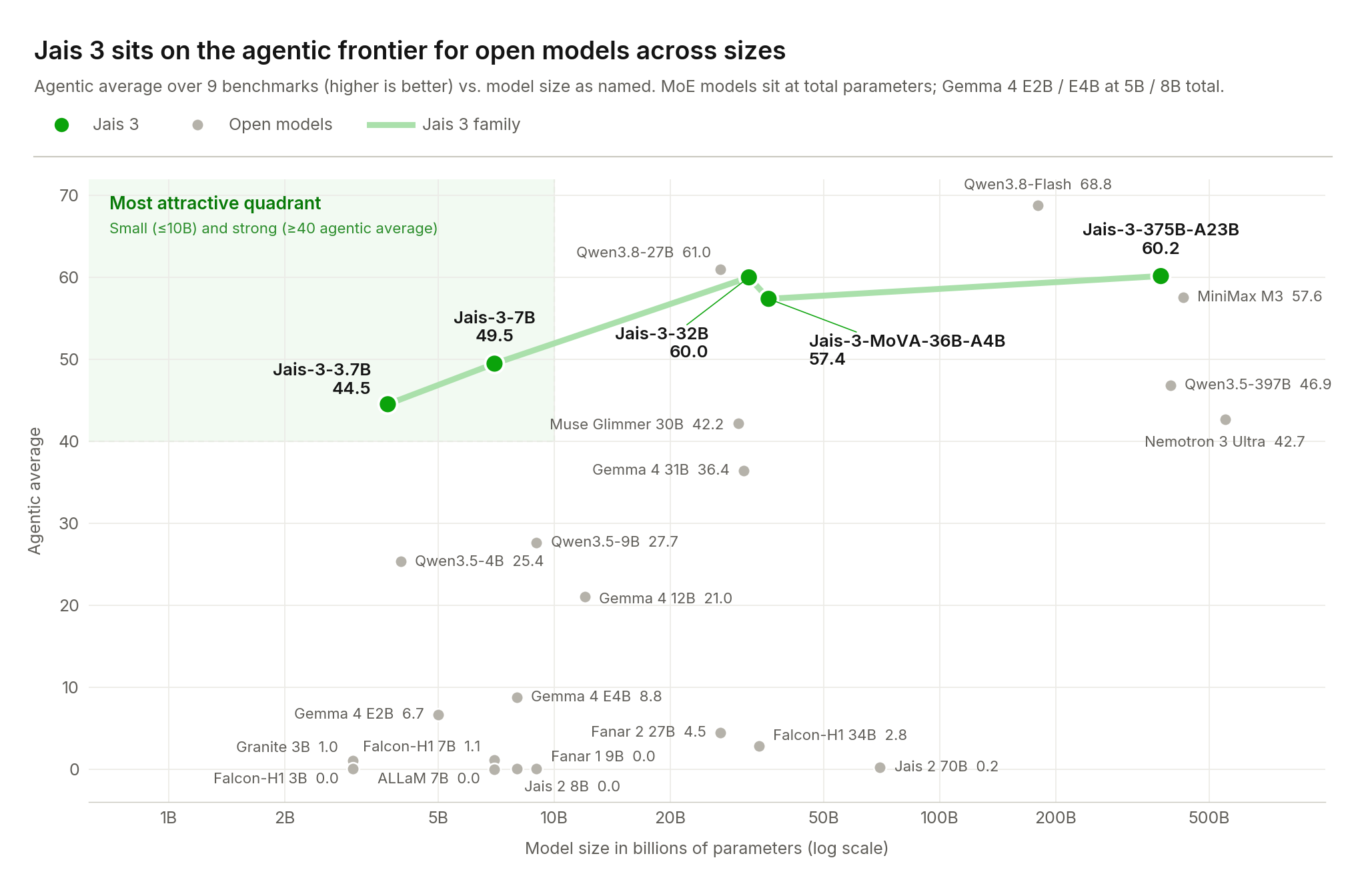
On agentic tasks, the 3.7B and 7B lead their size class by about 20 points, earlier Arabic-focused models such as ALLaM, Fanar and Jais 2 score close to zero, and only the two Qwen3.8 models score higher than our 32B and 375B.
Frontier scale: Jais 3 375B-A23B
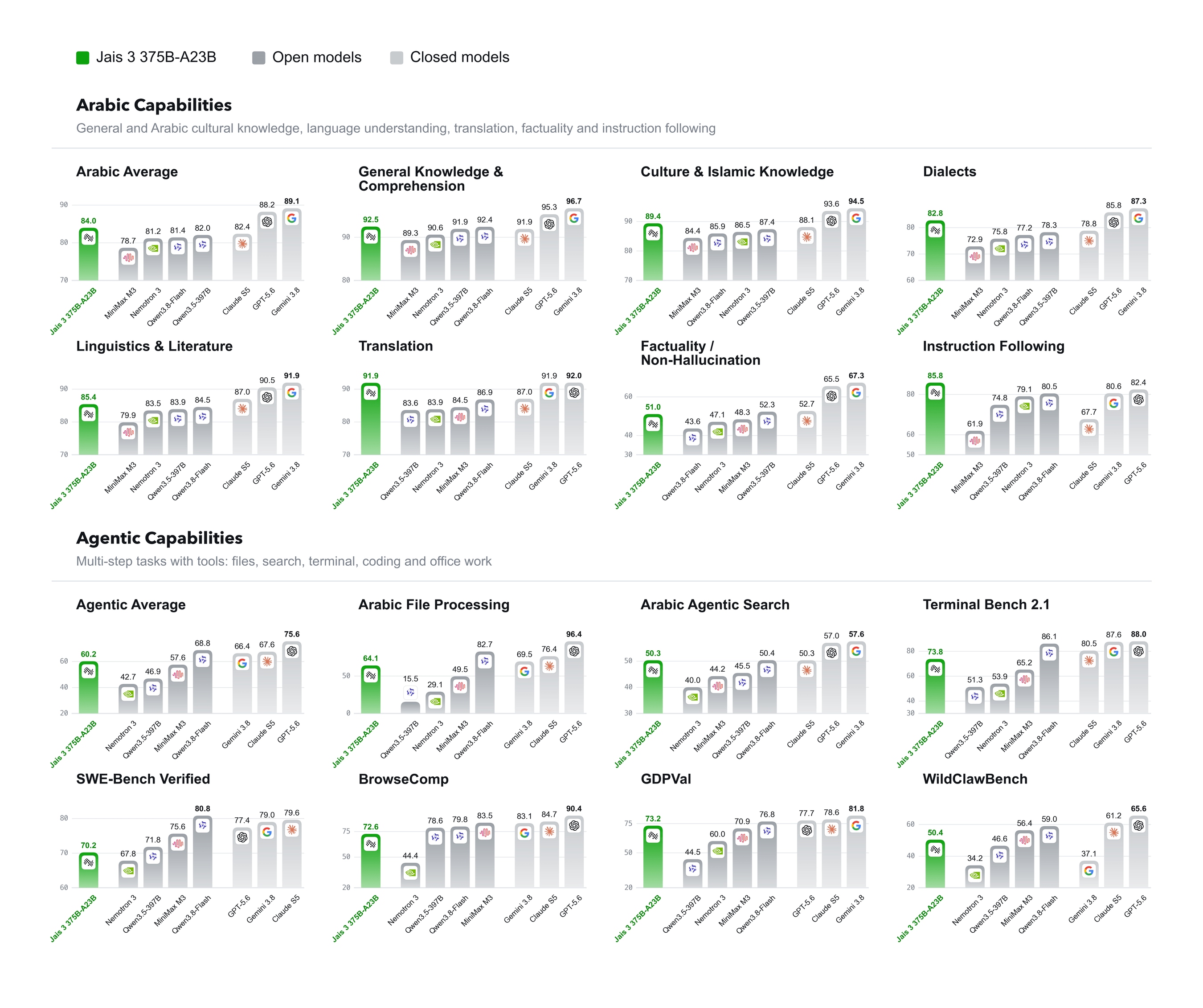
On Arabic, the 375B has the highest average of any open model we compared (84.0, against 82.0 for Qwen3.5-397B) and edges past Claude Sonnet 5; GPT-5.6 Sol and Gemini 3.8 Flash remain ahead. On agentic tasks it is second among the large open models we compared, behind Qwen3.8-Flash-Next, and well ahead of the rest on Arabic file processing.
Local deployment: Jais 3 32B, 36B-A4B and 7B
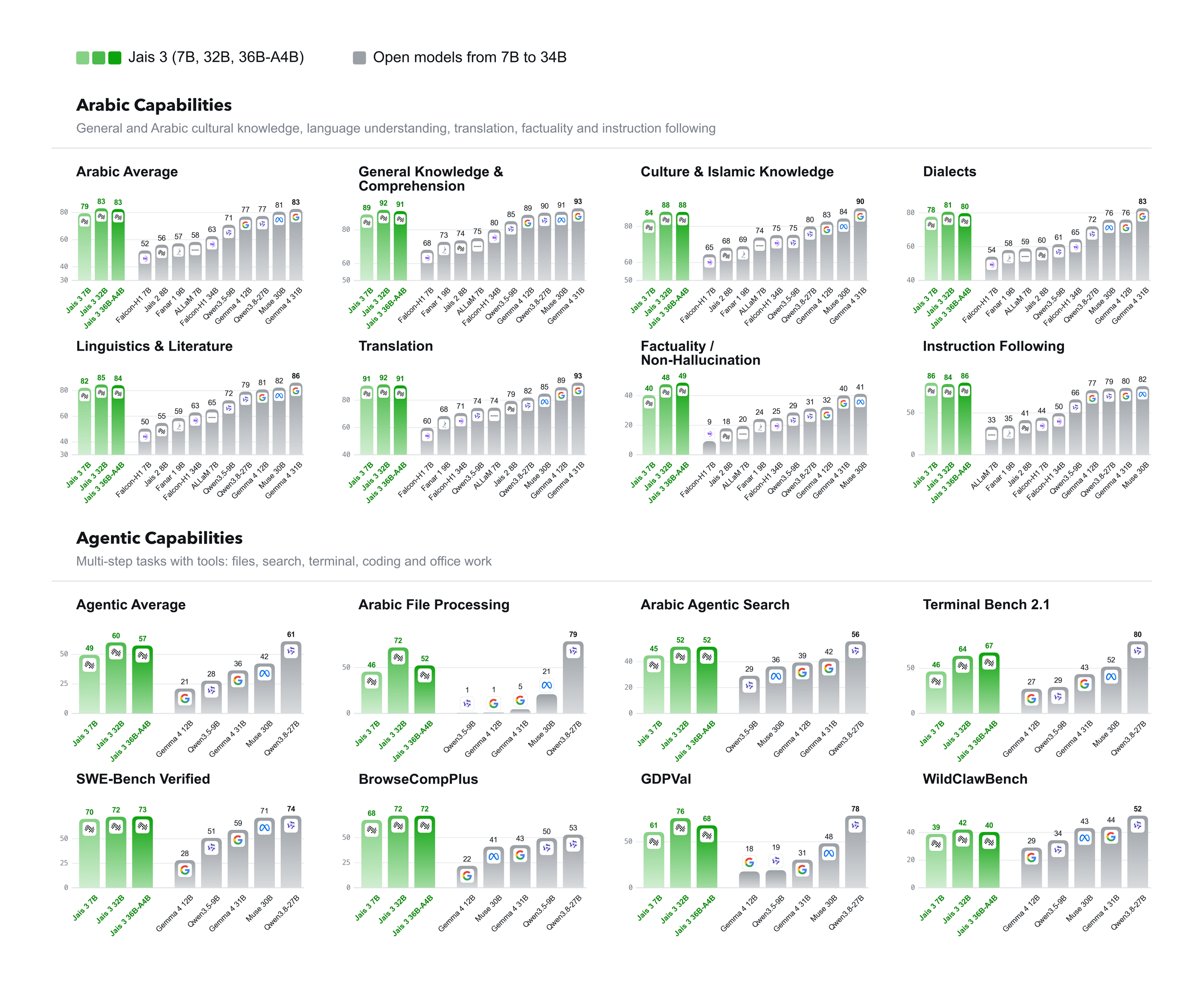
At workstation sizes, Jais 3 32B is level with Gemma 4 31B on Arabic (83.1 vs 82.6), and the 36B-A4B comes within a point of it with about 4B active parameters. Qwen3.8-27B is stronger on most agentic benchmarks but trails both Jais 3 models by more than five points on Arabic.
The 7B beats Jais 2 70B, our previous flagship, on Arabic (79.4 vs 66.7) and leads its size class on every agentic benchmark in the chart.
On-device and edge: Jais 3 3.7B and 0.9B
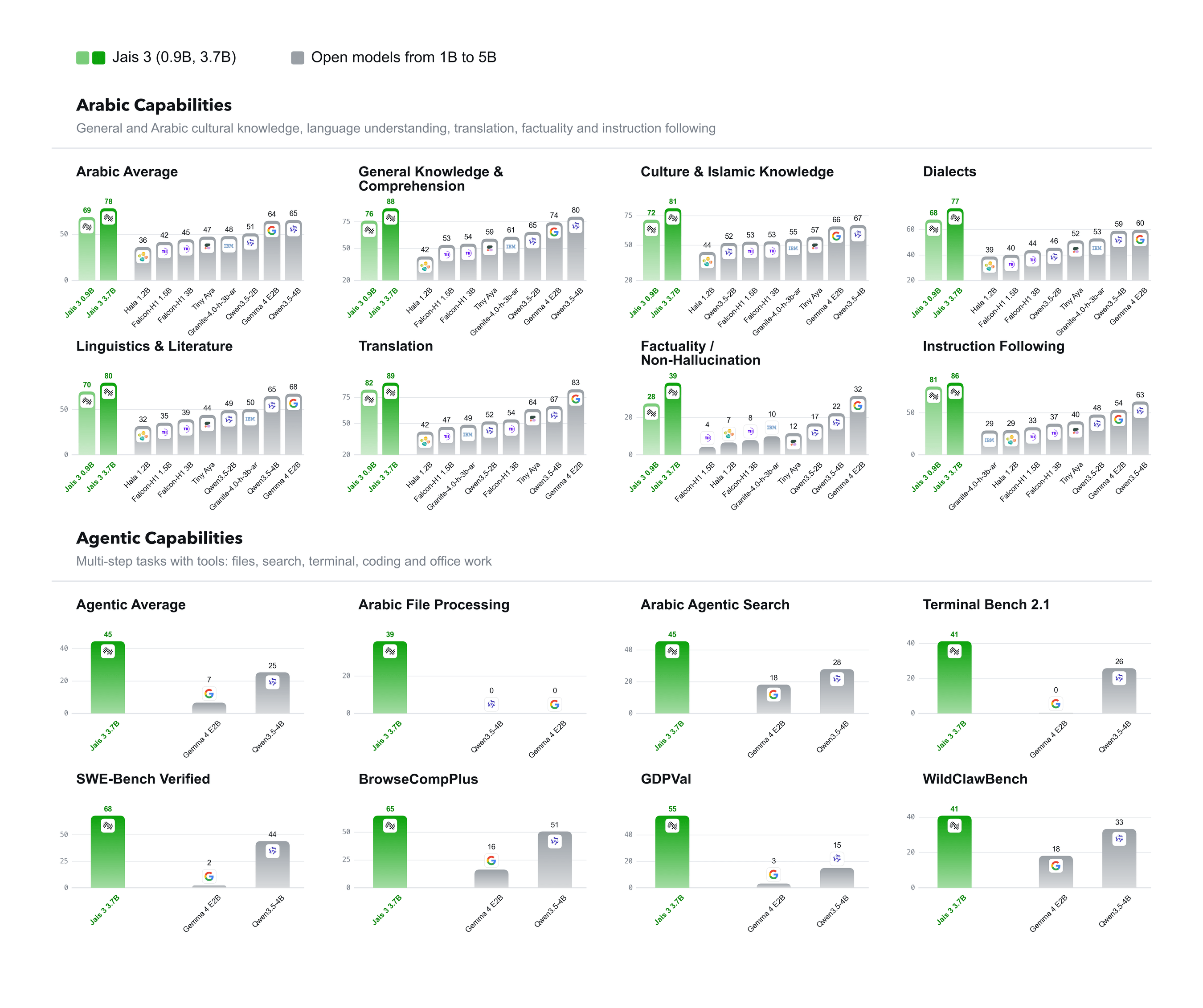
The gap is widest at small sizes: the 3.7B is 13 points ahead of Qwen3.5-4B on Arabic and leads on every benchmark in the chart, and the 0.9B beats every 3B-to-5B model we tested.
Full results for every size class are at the end of this post.
How we built Jais 3
Built on K2 Horizon
Jais 3 is trained on top of K2 Horizon, our fully open model family. Each Jais 3 model starts from the final, post-trained K2 Horizon model of the same size, and uses the same open training code. It is the first adaptation of K2 Horizon to a new language. Each model also keeps the architecture of the K2 Horizon model it starts from: the 0.9B, 3.7B, 7B and 32B are dense, the 36B-A4B combines MoE layers with MoVA attention, and the 375B-A23B is a mixture-of-experts model.
It also shows that an open foundation like K2 Horizon can be adapted to a new language without starting from scratch, and come out much stronger in it. The gains are largest at small sizes.
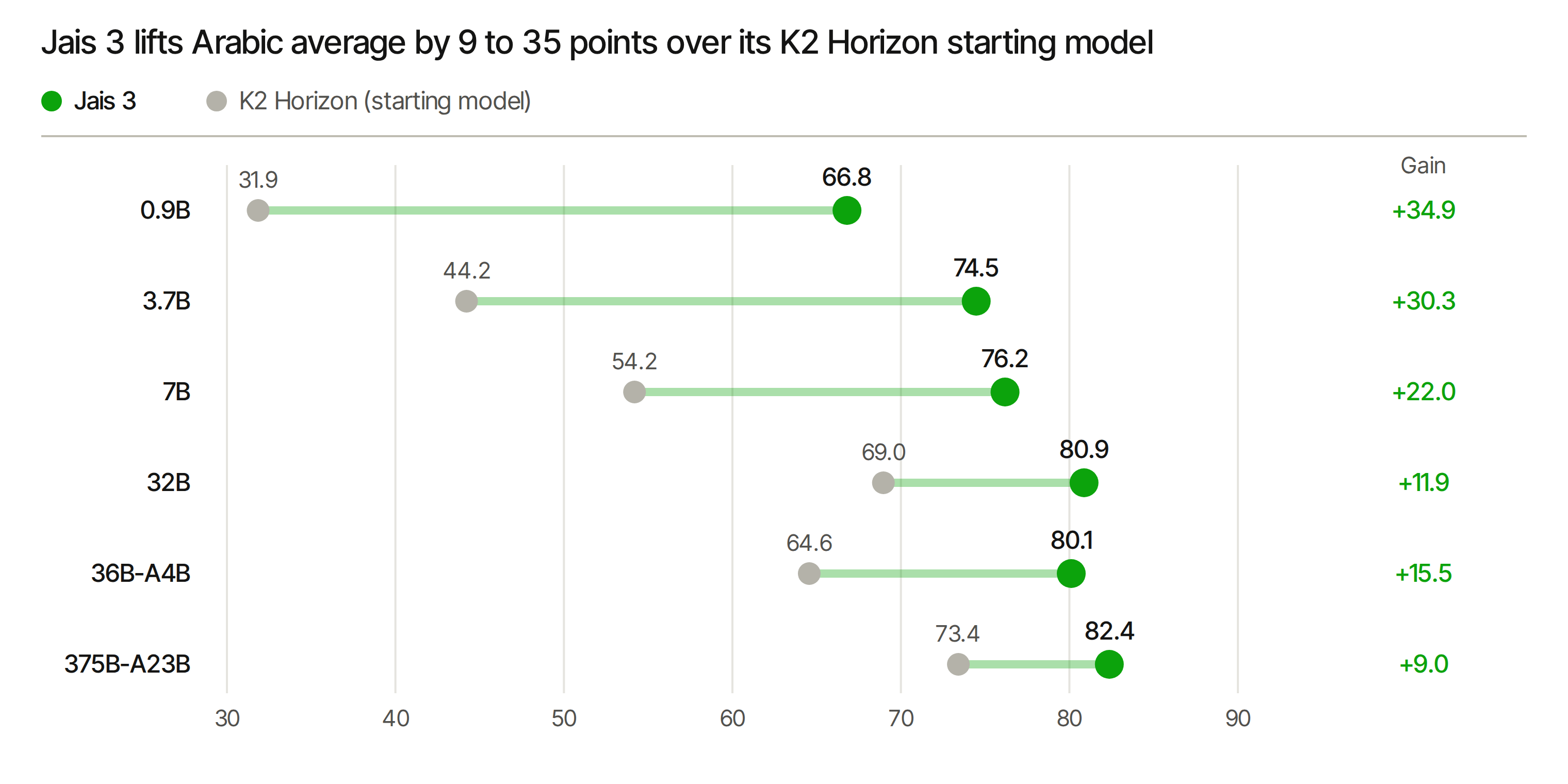
Adapting to Arabic cost Jais 3 little of what K2 Horizon could already do: it largely keeps its foundation’s general reasoning and English ability. See more details in our technical report.
Five stages of training
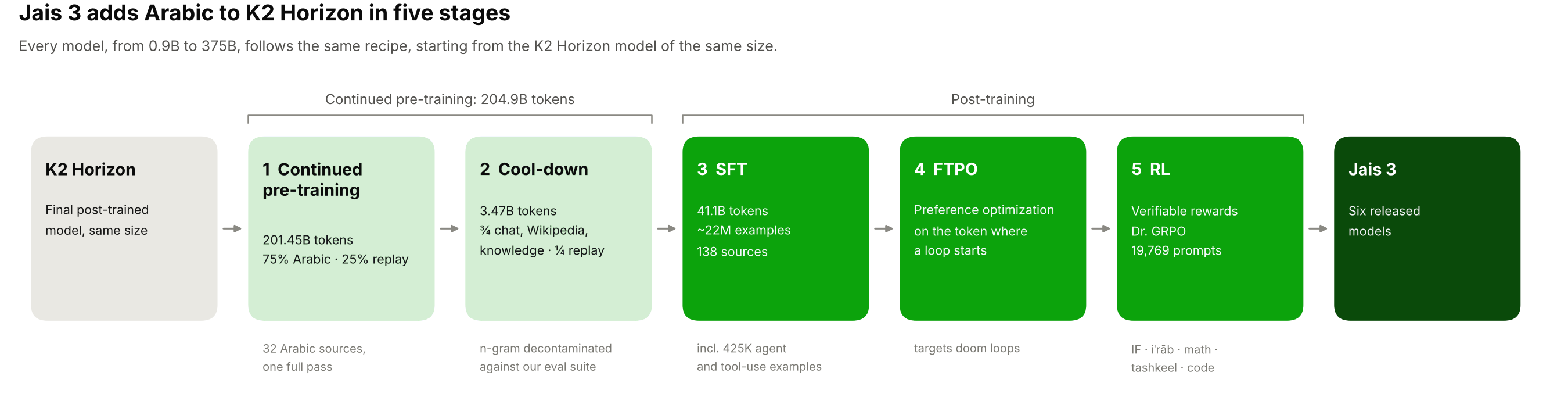
Each Jais 3 model goes through five stages, starting from the final, post-trained K2 Horizon model of the same size:
- Continued pre-training (CPT) on 201.45B tokens: 151.09B of Arabic text (75%), one full pass over 32 sources, and 50.36B tokens (25%) that replay K2 Horizon’s own mid-training data. We settled on 75/25 after ablations with 90/10, 75/25 and 50/50 mixes: it gave the best balance between learning Arabic and holding on to what K2 Horizon already knew.
- Cool-down on 3.47B tokens. Three quarters is chat-format data, Arabic Wikipedia, knowledge-focused text and task-oriented question-answering data. The last quarter is replay.
- Supervised fine-tuning (SFT) on 41.1B tokens: about 22 million examples from 138 sources, one epoch at 128K context. Besides English STEM, code, math and chat, it covers Arabic and Arabizi, dialects, translation, diacritics, grammatical analysis (iʿrāb), poetry meter, long-document QA, agents and tool use, and domain data for Islamic Q&A, finance, law, medicine, safety and UAE knowledge.
- FTPO (Final Token Preference Optimization, introduced in Antislop) with Liquid AI’s Antidoom recipe, which targets doom loops: reasoning that repeats the same span until it runs out of context. Rather than training on whole responses as DPO does, it trains only on the token where a loop starts, and pushes the model toward alternatives it already ranks highly. On the 7B it also adds about two points to the Arabic average. Averaged over the six models, it cuts the loop rate from 13.8% to 1.2%, and on the 7B from 14.1% to 1.45%.
- Reinforcement learning (RL) with verifiable rewards (GRPO with Dr. GRPO-style advantages) on 19,769 prompts (plus about 10.9K instruction-following prompts for the 375B) whose answers can be checked automatically, across five tasks: instruction following, iʿrāb, math, diacritization (tashkeel) and code. None of the RL tasks is agentic: Jais 3’s agentic skills come from the agent data in SFT, described below.
One lesson from these stages: in the two mixture-of-experts models, the inference engine and the trainer disagreed on token probabilities two to four times more than in the dense models from the first rollout, so their RL runs needed a truncated importance-sampling correction.
The Arabic data
The Arabic data comes from 32 sources. Four make up three quarters of it: machine-translated reasoning (20%), web data (19%), parallel dialect data (18%) and Arabizi, Arabic written in Latin letters (17%). The rest is a curated collection of classical books, news, transcribed speech, UN documents, poetry and religious texts (6%), and a mix of finance content, instruction data, LLM rewrites, generated Q&A and other sources (20%).

About 59% of the Arabic tokens are synthetic or machine-translated, and about 36% come from dialect-focused sources: Arabizi, parallel dialects and speech transcripts. We chose that mix on purpose, to add reasoning data and more of the Arabic people actually speak day to day.
For translated conversations, a strong open-weight model translates English conversations into the target dialect and script, and Jais 2 writes a second version. An LLM judge scores both from 1 to 4 on dialect accuracy, meaning and naturalness, and an automated check flags unwanted switches into other languages. A subset was also translated into Arabizi.
Long context
Jais 3 keeps the 512K-token context window of the K2 Horizon model it starts from, at every size except the 0.9B, which has a 128K-token window. That is room for a full contract or annual report in one prompt, or for an agent run where tool outputs pile up over many steps.
A large window only helps if the model can reason over what is in it, and Arabic long-context data is scarce. So we built our own: Arabic multiple-choice questions over long, natively Arabic documents such as books, legislation, financial and academic documents, news and fiction, with contexts of up to 128K tokens and a median of about 43K. Some questions need evidence pulled together from across the whole document; most hide the answer in one or two passages inside a long text, so the model has to find it first. This data makes up 7.1B tokens, about 17% of SFT. We test the result on AA-LCR (Arabic), where answers depend on several long documents at once. Jais 3 7B scores 65 against 49 for Gemma 4 12B, and the 32B scores 75 against 66 for Gemma 4 31B.
Agentic training data
Agent and tool-use data makes up 425K examples (5.8B tokens) of the SFT mix. To build it, one model played a user with a given persona, and a strong open-weight model did the work with real tool calls (read, write, edit and bash) on real documents. The pipeline went from personas, to three scenarios per file, to full trajectories.
A sovereign model for the UAE
Jais 3 is also a fully sovereign model for the UAE: every model in its chain, from K2 Horizon’s pre-training to Jais 3’s final RL stage, was trained by MBZUAI’s Institute of Foundation Models.
Open science: auditing Arabic benchmarks
While building Jais 3, we found that Arabic evaluation had fallen behind. Most protocols and leaderboards were designed for instruction-tuned models and no longer fit today’s reasoning models, and many benchmarks carry wrong answers or outdated questions.
We audited the benchmarks in our suite: about 50 Arabic and 20 English benchmark groups, 679 tasks in all. Whenever three independent frontier models all marked a question invalid, we removed it. On Arabic MMLU alone, correcting 765 of its 14,455 questions moved one internal checkpoint by 4.03%.
We also changed how models are scored. Log-probability scoring, where the option the model finds most likely counts as its answer, no longer reflects how reasoning models are used: they think first, then answer. We converted every benchmark to generation-based evaluation, so models are scored on what they actually write. All Arabic scores in this post come from the audited benchmarks, scored this way, and both changes apply to every model we evaluated, not just ours. They shift individual scores, but they do not change how Jais 3 ranks against the other models. To ensure a fair evaluation, we checked the data we added for pre-training, cool-down and fine-tuning against our evaluation benchmarks for n-gram overlap, and removed anything that matched.
Open release
If you are building agents for Arabic speakers, try Jais 3 on your own tasks and tell us where it breaks, on Discord or X. If you work on another language, the stage checkpoints and recipes let you adapt K2 Horizon to it the same way we did.
Appendix: full results
All scores are percentages from the final checkpoint of each model. Bold marks the best score in each row; rows where Jais 3 has no score have no bold. A dash means the benchmark has not been run for that model yet.
To keep the tables readable, we group the Arabic benchmarks into three domains and ten subdomains. Each subdomain is the plain average of its benchmarks. The Arabic average and the three domain averages are taken as computed in our evaluation sheet, so they are not simple means of the rows below them (for example, the Arabic and domain averages weight every benchmark equally, so a subdomain with more benchmarks counts for more). Agentic benchmarks are few and widely known, so we report them one by one; the agentic average is the plain mean of all nine. At 375B, BrowseComp-Plus is replaced by BrowseComp, run with each model’s own harness, and three closed frontier models are shown for reference; bold there marks the best open model.
375B-A23B
Bold marks the best open model. Closed frontier models are shown for reference.
Scroll horizontally on small screens to compare all models.
32B and 36B-A4B
Scroll horizontally on small screens to compare all models.
7B
Scroll horizontally on small screens to compare all models.
3.7B
Scroll horizontally on small screens to compare all models.
0.9B
Scroll horizontally on small screens to compare all models.
Jais 3 is developed by the Institute of Foundation Models at Mohamed bin Zayed University of Artificial Intelligence (MBZUAI), in collaboration with Inception and Cerebras.